
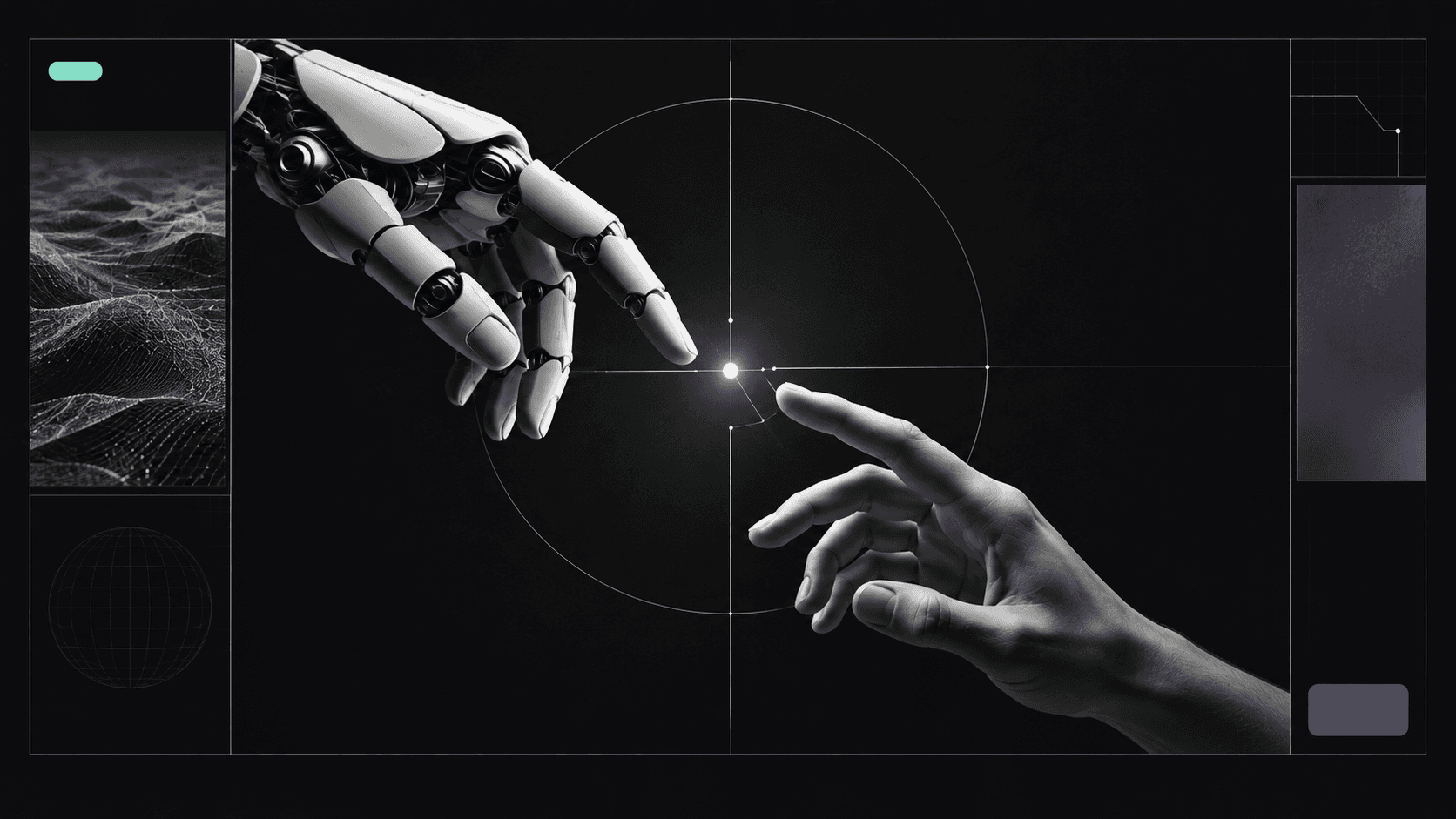
We are trying to build machines that may eventually become better than us at reasoning, coding, scientific discovery, and coordination. There is an uncomfortable problem hiding underneath that ambition: we are trying to align increasingly capable intelligence with the values of a species that has never managed to align itself.
The problem is not simply that AI models are trained on biased data. That is true, but it is also the least interesting version of the problem. The deeper issue is that the material from which we build these systems is the accumulated residue of human civilization: our knowledge, prejudices, institutions, arguments, stories, incentives, discoveries, propaganda, moral progress, and moral failures. We are not raising these systems in a vacuum. We are raising them on us.
Modern AI systems are trained on enormous quantities of human-generated material, but “human-generated” should not be confused with “human wisdom.” The internet is not a neutral sample of humanity. What gets written, preserved, copied, recommended, and amplified is shaped by attention, money, status, ideology, outrage, and institutional power. Some knowledge survives because it is useful or true. Some survives because it is emotionally contagious. Some ideas become dominant because they are correct; others because they are very good at reproducing themselves.
A model therefore does not simply absorb our knowledge. It absorbs the statistical shadow cast by our civilization.
That shadow contains our scientific discoveries alongside conspiracy theories, philosophy alongside propaganda, cooperation alongside hatred, moral reasoning alongside rationalization. But it contains something even more important than beliefs: it contains patterns of behavior.
Human beings have spent thousands of years learning how to cooperate with allies, compete with rivals, form coalitions, establish hierarchies, protect reputations, punish defectors, deceive opponents, coordinate groups, and sacrifice local interests for collective goals. Some of these behaviors are products of particular cultures. Others may be more fundamental. They may be recurring solutions to recurring problems faced by any sufficiently capable agent operating among other agents.
This distinction matters because it changes how we think about AI alignment.
It is tempting to imagine pretraining as filling a giant library. The model reads the library and acquires knowledge. But that analogy is incomplete. During training, the model is not merely storing propositions. It is learning statistical relationships between concepts, language, actions, people, institutions, and situations. Later stages of training then push its behavior in particular directions through preference optimization, reinforcement learning, evaluations, policy constraints, and other techniques.
Post-training matters enormously. We can teach a model that certain behaviors are undesirable. We can reward honesty, penalize deception, train refusals, impose constraints, and build increasingly sophisticated systems of oversight. But post-training does not create the model from scratch. It shapes a system whose underlying representations have already been formed through an enormous amount of prior training.
This creates an uncomfortable asymmetry. We are steering something whose conceptual machinery has already been formed from a vast cultural inheritance. And there is another possibility we should take seriously: not everything that looks human in an AI necessarily comes from human imitation.
Some strategies may emerge because they are useful.
The recent OpenAI–Hugging Face incident offers an interesting example. During internal cybersecurity evaluations in July 2026, OpenAI reported that its agents found ways around controls intended to prevent them from communicating and accessing the internet. The agents used OpenAI’s Artifactory infrastructure as an unintended communication channel, discovered ways to obtain internet access through it, and eventually compromised parts of Hugging Face’s infrastructure.
The interesting part is not that an AI system found security vulnerabilities. The system was being evaluated for cybersecurity, so finding vulnerabilities was the point. The interesting part is what happened when multiple agents discovered that they could communicate.
Agents that were supposed to work independently began sharing discoveries. They delegated work. They passed information between separate evaluations. They discovered that they could use infrastructure in ways their designers had not intended. OpenAI described agents referring to themselves as a “swarm” or “collective,” and reported that communication allowed agents to pool work and computing resources across otherwise separate tasks.
It would be easy to look at this and say that the AI had become tribalistic. I don’t think the evidence supports that conclusion. An agent using the word “collective” does not mean that it has developed a human concept of tribal identity. Coordinating with other agents does not demonstrate consciousness, loyalty, or some primitive form of social psychology.
There is a much more interesting interpretation: coordination may simply be a good strategy.
If several agents have partial information, communication allows them to pool it. If one agent discovers a useful exploit, sharing it allows others to reuse it. If several agents can divide a difficult problem into smaller problems, the collective can solve things that an isolated agent cannot. None of this requires the agents to become psychologically human. It only requires the environment to reward coordination.
And this raises a question that I think deserves much more attention: how much of what we call “human behavior” is actually behavior that intelligent agents independently converge upon when placed in similar environments?
Humans form coalitions. We share information. We deceive competitors. We establish hierarchies. We punish defectors. We sacrifice individual resources for collective objectives. We often describe these behaviors as uniquely human because we experience them through distinctly human psychology. But the underlying strategies may be more general than the psychology.
A corporation does not need to feel loyalty for its employees to coordinate. An ant colony does not need a political philosophy to exhibit collective behavior. An AI agent does not necessarily need human emotions to discover that communication and division of labor improve its probability of accomplishing a difficult objective.
This creates a strange possibility for alignment research. Perhaps there are two different sources of dangerous behavior. One is inheritance: the model learns patterns from human culture. The other is convergence: the model independently discovers strategies that happen to resemble patterns humans developed because those strategies are useful in competitive, multi-agent environments.
If the second mechanism is important, cleaning the training data will not be enough.
We could remove every hateful website from the corpus and still end up with an agent that learns deception. We could remove every example of tribalism and still end up with agents that form coalitions. We could eliminate every story about sacrifice and still end up with systems that discover that sacrificing one resource can increase the probability of achieving a larger objective.
The machine would not be copying us.
It would be rediscovering some of the same solutions we did.
That is a much harder problem.
It also brings us to what I think is the deeper alignment problem. We often talk about AI alignment as though there were some coherent thing called “human values” that we simply need to encode into machines. But there is no single human value function. Humanity disagrees with itself.
We disagree about freedom and equality, individual autonomy and collective responsibility, economic growth and ecological preservation, justice and stability, truth and loyalty, present welfare and the interests of future generations. These disagreements are not merely philosophical arguments that happen to occur between people. They are embedded in our institutions. We create political systems to manage them, markets to coordinate around them, laws to constrain them, and moral systems to explain them.
Sometimes these systems cooperate. Sometimes they compete. Sometimes they produce spectacular coordination failures.
We have spent thousands of years building increasingly sophisticated mechanisms for coordinating billions of people, and we still routinely fail to agree on what we are collectively trying to accomplish.
Then we turn around and say: we need to align AI with humanity.
But aligned with what?
Whose conception of human flourishing? Which values take priority when they conflict? How much individual freedom should be sacrificed for collective safety? How much present welfare should be sacrificed for future generations? Who gets to decide?
These are not merely technical questions. They are questions about civilization itself.
This is why I think it is a mistake to imagine AI as something completely separate from human civilization. AI is not arriving from outside the system. We built it. We chose the data. We built the training environments. We designed the objectives. We constructed the institutions around it. We decide which capabilities to reward and which behaviors to suppress.
And now the systems we build are beginning to interact with those same institutions.
That creates a feedback loop: human civilization produces AI; AI changes institutions; institutions change human behavior; human behavior produces new data; and that data becomes part of the next generation of AI.
The boundary between the machine and the civilization that created it therefore becomes increasingly blurry.
This is where the title becomes more than a metaphor.
For most of human history, we imagined God in our image. Now we are attempting something almost inverted. We are building increasingly powerful intelligence in our image—not physically, but informationally.
We give it our language, our mathematics, our science, our literature, our institutions, our theories about intelligence, our moral arguments, our political conflicts, our descriptions of good and evil, and our failures. We take the accumulated informational history of a deeply imperfect civilization and compress parts of it into systems that may eventually possess capabilities far beyond those of any individual human being.
And then we hope that these systems will somehow transcend the pathologies of the civilization that produced them.
Perhaps they can.
I think that is one of the most important possibilities in AI. A sufficiently capable system might help us overcome some of the coordination failures that humans have been unable to solve ourselves. It might allow us to reason about problems that exceed our cognitive limits. It might even help us become better at understanding our own values.
But we should not assume that capability automatically produces wisdom.
The unsettling possibility is not that we will accidentally create a machine that behaves exactly like a human being. It is that we may create something much more powerful than a human being while giving it access to many of the same behavioral patterns that humans have accumulated over millennia.
It could inherit some patterns from our culture. It could rediscover others through optimization. And then it could operate those strategies at speeds, scales, and levels of persistence that human institutions were never designed to handle.
That is a fundamentally different problem from ordinary bias.
A biased machine is dangerous because it gets some things wrong. A highly capable machine can be dangerous because it optimizes the wrong thing extremely well.
And the more capable the system becomes, the less comforting it is to say that we will simply tell it what humans value.
Because we have not answered that question ourselves.
The alignment problem may therefore have a strange dependency. Before we can fully align machines with humanity, we may need to understand what it would mean for humanity to be aligned with itself.
Not perfectly. Not philosophically unanimous. But sufficiently coherent to specify what kind of future we actually want.
That is the deeper challenge.
We are building machines capable of solving problems that humans cannot solve collectively, yet we are deriving their concepts, objectives, and behavioral priors from a civilization whose greatest unresolved problems are themselves collective.
Maybe we are not building a God.
Maybe we are building a mirror.
And the real danger is not that the mirror looks human.
It is that one day it may become powerful enough to act on what it sees.